Wednesday, April 14, 2010

Mother Earth rights


Last post, I showed a local example of the complete disregard for the rights of Mother Earth's creatures. Bolivian President Evo Morales is tackling this sort of abuse of Mother Earth and all her inhabitants by calling for Earth Rights. As Vanessa Baird writes, Morales is taking a lead in tackling rich world inertia. He has called for a People's World Conference, and one of the areas of discussion will be:

Discuss and agree on the project of a Universal Declaration of Mother Earth Rights.

If corporations are treated as persons in the current policies, trade agreements, and legal documents of capitalist empire, why not legislate the rights of Mother Earth and her inhabitants, like those smelts the local angler killed for no reason but his/her own pleasure and laziness?

As Vanessa Baird explains:

“Bolivia’s position on climate change has not come out of the blue. It has its roots in Andean thought and belief with its key concepts of Sumaq kawsay or Vivir bien (living well) and respect for Pachamama (Mother Earth).

These principles could provide the basis for an alternative development path that is not driven solely by ideas of growth, profit and capitalist accumulation. Pablo Solón explains: ‘We use terms like “living well” to describe a way of life that seeks not to live “better” and at the cost of others and nature, but in harmony with all.’1

This seems so far removed from the way that most of the world operates as to suggest dreamy idealism. But in recent years indigenous people and social movements in Latin America have managed to get such perspectives enshrined in the new constitutions of both Bolivia and Ecuador. The concepts are also gaining traction around the world with non-indigenous people who are concerned with environmental and social justice.”

Tuesday, April 13, 2010

Canadian anglers

Our local paper has a Thumbs Up/Thumbs Down section, where anyone can send in something either uplifting or troubling for everyone to think about. So, after my morning walk I sent in this:

Thumbs down to the angler who dumped his/her entire catch of smelts into McVicar's Creek. If not criminal, this act is certainly obscene. Dumping your catch of smelts is a complete disregard of the gift of life that fish give us. The dead smelts, a couple of hundred, are lying on the bottom of the creek, just down from Court St. I thought Canadians respect nature. Well, this morning I felt sick to my stomach to see those dead smelts wasted like that. Fishing is not entertainment. Next time stay home and watch tv instead of killing senselessly.

Saturday, April 10, 2010

humility

This morning, when I went downstairs with Sydney, our lovebird, on my shoulder, and like many mornings, I first went to open the drapes of the living room window, I looked out through the window and through the porch windows and saw two tiny redpolls, one with a big bunch of dried fluff in its beak, the other bobbing expectantly on the wire beside it. The one with a mouthful of earth recyclables, darted straight into the cedar shrub that grows perilously close to the window panes of our front porch, planted years ago by some previous owner much too close to the house. With a flash, the other redpoll also darted into the bush.

I turned to Sydney and said, "Isn't that cute? Did you see that? Those redpolls are making a nest in our cedar bush." Then I put her in her cage.

I pulled downed one of my books off the shelf to find a poem this morning. Harmoniously, the poem that released itself from the spine of the book, mirrored the words of Raymond Moriyama, a renowned Canadian architect, who I heard on CBC radio as I made myself a cup of coffee. He spoke of the effects of having been interred as a Japanese Canadian as an 'enemy alien' in an internment camp in Canada, the racism he faced as a youth, and the lifelong lessons he learned from the earth speaking to him when he made a tree house as a sanctuary from the racism he faced. He spoke about how through his years of escape to his treehouse the earth showed him light, gave him the lessons he learned that guided the principles of the architecture he has designed, and the way he lives his life. He spoke of the 3 'l's": listening, learning, and leading. He also spoke of the words of his grandfather, of a saying his grandfather passed down to him, which translates from the Japanese to English to: "even the monkey falls from the tree." Moriyama says he has kept his Grandfather's lesson of humility in his heart.

The Holy may speak to you
from its
many hidden places
at any time.

The world
may whisper in your ear.

Or the spark of God in you
may whisper in your heart.

My grandfather showed me how
to listen.
~ Rachel Naomi Remen pg. 67 WomanPrayers

Tuesday, April 6, 2010

a woman's worth

Below is a poem I wrote a few years back. I had been berating myself for not being able to get one of my friends to "see" what it was I was saying, despite my abilities to articulate myself 'rationally' and logically. Over coffee, she had confided to me that she was being beaten by her husband, but I was unable despite all of my education to say anything that made any real difference. What was the use of my work on women's issues when I couldn't even help my friend on the most basic everyday level?

As I went about my kitchen chores the next day, my inability to say anything practical to her nagged at my mind, bothering me. I spontaneously decided to go to the Northern Woman's Bookstore. Maybe a book might have the answer, or provide some direction, I thought. So, I went looking for a book, what kind I didn't know but I thought I needed a self-help, what-to-do to help a friend who is being abused kind of manual. Some kind of a social work, psychology based book, that would tell me step-by-rational-step what to do, what to say, how to help.

Well, I didn't find a book, I talked to Margaret, the owner, instead. She listened patiently as I voiced my confusion and incompetency. The books I browsed as I talked with Margaret stayed on the shelves and I left without buying one. When I came home, I sat at the kitchen table and wrote down these words.

A woman's worth

Upon hearing of the beating
of wings
stifled in the craw
of a slender throat.

A woman’s worth
is not the guts to do it or
the number of checkmarks
she scores in the morality
book of the nation,
or her extended family.

It is not measured by the scales of shame.

A woman’s worth
is not found in size 5
knees-together skirts,
in the tightness of a non-tummy,
or a toe-ring.

A woman’s worth
is found in the soft white feathers
flying, unexpectedly,
at the corners of her eyes.

A woman’s worth
is found in her grandmother’s legs,
the strides she takes
each morning
towards the little girl
still
on the other side
of the looking-glass.

A woman’s worth
echoes from the smallest sigh
at the kitchen sink
reverberates in the canyons
of her soul.

A woman’s worth
is not found under the thumb
of a man’s need, in the ripple
of his insecurities, or monitored
by the pulse in his left cheek.

A woman’s worth
is not found in the clamp of jaw
the bite of tongue
the downcast eye
the corset of her feelings, rib-caged.

A woman’s worth
is not found by wishing
washing or wallowing
in pink pill-popping
serotonin serenity.

A woman’s worth
is not found
in a swan song
a startled deer
yellow wallpaper
shrinking violets
or minced words, tied
to a heart, crushing.

A woman’s worth
is found in the notebooks of a dreamer,
the father’s daughter, who,
woke up one morning and said,
I won’t be part of it.

A woman’s worth
is found in the magic wand
she wields while walking
her own terrible landscape.

A woman’s worth
streams through her veins,
coursing through the untrodden
garden of her body.

A woman’s worth
is found behind the unlatched gate,
between the leaves
of the Tree of Good and Evil,
inside the nesting dolls,

find Persephone.

Sunday, April 4, 2010

geese, gulls and a Windigo

Last weekend I was back in Fort Frances. Here are some photos I took. Right next to the Nanicost Building where Seven Generations Education Institute is housed, is Rusty Myer's Fly-in Outposts where you can charter a plane to go fishing to some inland camp or resort. The colours of the old oil barrels caught my eye, but I am sure this is not the image you will find on Rusty Myer's promotional literature.
Saturday morning when I woke up and looked out the window of our hotel room, this is the sunrise I saw coming over Rainy Lake. As the ice on the lake was well on its way to thawing, the ice huts of the Americans, which earlier were lined up along the US side of the lake, were now packed in for the season.
The next day the same lake, the same horizon, looked like this.
Along the lake, at Couchiching Point, there are numerous trees, most covered in lichen on the north side of their trunks.
By the shore, someone had left behind the pike carcasses that they had cleaned the fillets from.
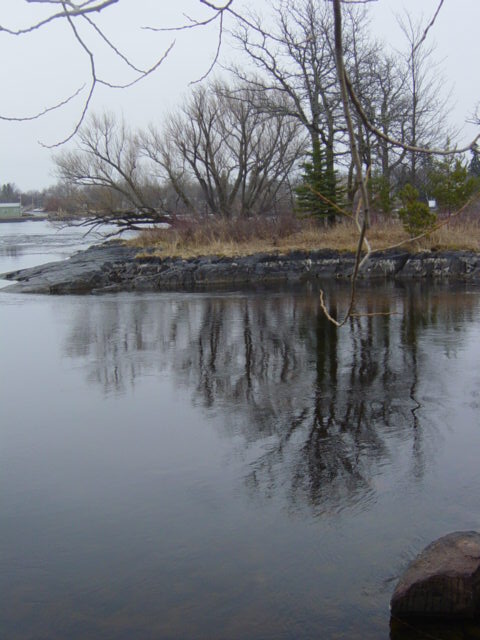
Right after the rail bridge to the US, a small island sits smack dab center of Rainy River, midway between the US and Canadian banks.
Looking down, I saw interesting orange coloured dried out grassy weeds
that looked like the fur of an old bear.
There are some large old red pine logs along the shore here;
perhaps there used to be a dock of some sort here in days gone by. The logs are weathered but their pinkness is still visible.
Along the railway tracks, red willow bushes jumped out.
Closer to the beach, a large, very noisy flock of ring billed gulls sat on the residual slushy ice lining the shore. I was puzzled why they were all facing south west. Perhaps they were listening to an early evening wind symphony.
Further down the beach, a large flock of Canada Geese stood at the ridge of the water, jeweling the large stain glass plate of ice.
We had stopped at Lake Windigoostigwan on the way down. When we got out of the car, the wind was whipping with a fury. I went off to climb the "killing stone," and sure enough, I found a few more feathers. The raptors have not eased up on their hunting. I heard a loud moaning and groaning coming from this direction. I wasn't sure what it was. At first I thought there was something down there, something or someone by the shore. Then, I thought it might be the sound of the water calling out from beneath the ice as it was cracking up. The moaning and howling traveled through the trees. It sounded very eerie.
From the same spot, but from this direction, you enter the magical enchanted forest at Lake Windigoostigwan. The path will lead you down to the lake. It is one of many paths, for the lake is huge. The sounds of the moaning, however, combined with the wind whistling through the trees, prevented me from following the path. I said to myself, "this is silly; there is nothing down there. My ears are playing tricks on me." Still, I felt apprehension to keep going, so I turned around and went back the way I came.
When I got back to the car, my husband asked me, "Did you hear those drums? Someone is drumming, I think."
"No, it is not drumming," I said, not quite convinced. "Although it sounds like someone is drumming." We looked across the lake. I said, "No, no one is drumming. Don't you know what lake this is? This is the lake of the Windigo."