Saturday, November 6, 2010

Vanhemmat: Those Older Than You

It's dark outside my window, completely black. I just felt like a poem today; must be the influence of Kekri calling out to my soul, telling me to start gathering up word magic as winter is coming. So I am sharing with you a "postcard" poem I wrote about this time a few years ago. It's a postcard poem not because it gets sent out in the mail but because it fits onto a postcard sized blank card. Above, you can see the collection of postcard poems I took with me once when I went out to read poetry around town.
Part of the Random Acts of Poetry (RAP) crew I joined one October: Dave, Duncan and Rene on the steps of Hillcrest High School. I'm at the bottom of the steps, behind the camera. We wear these orange worker's overalls because we are the word construction crew.

Over the last five years when I roamed the streets of Thunder Bay in early October with a Random Acts of Poetry crew, I found that it was more effective to have short poems as you never knew who your audience would be, so I worked on crafting shorter poems. I also found out that it was more comfortable to hold a stiff small card in your hand than an 8"x11" paper. I had used regular paper the first year but didn't like the sloppy ruffling and shuffling through papers; it made you nervous; you could lose your words, or just get confused. Short and sweet worked the best.
Once, the RAP crew I joined went to a seniors' residence. We have read to many different audiences, including at public libraries, coffee shops, on a high school stage, in university classes, at a health center, a dog park, in front of the Hoito, random stops on the street, the Northern Women's Bookstore, the Farmer's Market, and Lakehead University Radio.

I liked the postcard poem format also because if it was windy on the day we went out, and we had outdoor stops, well, it could be hard to find your words on a rattling piece of paper that was threatening to blow away. So, I discovered this postcard method. I bought a pack of blank postcard sheets at a local stationary shop, wrote a poem on one side and decorated the back of the card with random cut-outs from magazines and scraps of left-over paper I collect in a shoebox.

I am also challenging myself to use less words to say something. Maybe this is good for winter. Short and sweet -- but you won't find me Tweeting.
image from Suomalaisia Kansansatuja (Finnish Folktales). 1981. This picture by Matti Waren illustrates the story "Utelias akka," which translates to "The Curious/Nosy Old Woman." I found this book of stories at a rummage sale at the Finlandia Club.

Vanhemmat. Those Older Than You.

The wind bending tall grasses
brings memories of an old woman,
her earthy smell precedes her.

Those who have lost their amulets
cannot hear her footsteps
nor see her crazed dance.

An old man follows, his beard
gnarled like the wayward fur
of a pukki, a goat gone the wrong way.

Although the people busy themselves
buying rooms and closets full of stuff
there is hope that one day, they too
will greet Grandmother and Grandfather

Muori ja Faari
Akka ja Ukko
Eukko ja Mies
Mummo ja Pappa
Emȁntȁ a ja Isȁntȁ
Ȁiti ja Isȁ

The vanha pari/old pair
part of you.

Thursday, November 4, 2010

memoricide and Canada Park

image source Jerusalem Post. "First Autumn Crocus Blossoms in Canada Park." The article in the JP is about back-to-nature opportunities for Israelis that Canada Park provides. Yet, this photo, while seeming idyllic is, in fact, part of "memoricide"-- these Israeli people's enjoyment is provided by Canadian dollars at the expense of the dispossession of Palestinian people and the loss of their homes, villages, and lands. Palestinian people are removed from the nature. While the sweet Israeli girl in the photo above gets to enjoy the flowers in Canada Park, Palestinian children are not only denied this back-to-nature experience, they have lost their futures in this place.

One of my acquaintances, Yves Engler, has written a new article detailing the Jewish National Fund of Canada which built Canada Park in Israel with money raised in Canada. Engler has written a number of books on Canadian foreign policy, with a focus on Israel and Palestine. Earlier this year as part of a cross-Canada book tour that began in Vancouver, he came to Thunder Bay. A group that I am involved with arranged an evening talk at the university for Engler to discuss ideas from his latest book, Canada and Israel Building Apartheid. The talk was well attended and Engler provided the audience with many examples throughout Canadian history where Canada has clearly supported Israeli colonialism and Jewish settlers to Palestine.

In a recent article on Counterpunch called "Canada and the Jewish National Fund," Engler provides examples of Canadian support to the Jewish National Fund: in the late 1920s that helped them secure lands in Palestine for Jewish settlers; after the 1967 war to build Canada Park on illegally confiscated Palestinian land (which I told you about earlier in a number of posts); then, in the early 1980s, "JNF Canada helped finance an Israeli government campaign to "Judaize" the Galilee, the largely Arab northern region of Israel"; and more recently in 2007, JNF Canada has launched a campaign to raise $7 million to refurbish Canada Park.

Canada Park is barely discussed in Canadian media, so many Canadians would not be aware of its existence nor the fact that it was built using Canadian money that is tax deductible and that, disturbingly, it was built illegally on land where Palestinian villages and homes were destroyed, 10,000 Palestinian people were removed, and everything then removed from the pages of history -- a process called memoricide. Indeed, as Dr. Ismail Zayid notes about the tourist literature for Canada Park:

"The glossy guidebook, published by the JNF of Canada, has an entire page devoted to the history of the area, including the biblical, Roman, Crusader and British periods, but has no mention of these villages or their destruction. Another step in the obliteration of the villages from memory can be seen in their absence from Israeli maps."

Canadians need to become aware of how Canadian dollars and support are complicit in the continuing dispossession of Palestinian people through Canada Park, and we need to speak out about the tax deductions that Canadians get for donating money to the JNF Canada for this purpose.

You can learn more about the specifics of Canada's increasingly conservative positions internationally as Yves Engler will be returning to Thunder Bay at the end of November to give a talk on why Canada lost its bid for a Security Council seat. Along with endorsing the Israeli invasion and attack of Lebanon in 2006, voting against UN Resolutions on the rights of Palestinians. cancelling $15 m. in funding to Palestinian refugees via UNRWA, and "Heavily invest[ing] in training a Palestinian security force designed to oversee Israel’s occupation of the West Bank ... 'to ensure that the P.A. [Palestinian Authority] maintains control of the West Bank against Hamas,' as Canadian ambassador to Israel Jon Allen was quoted as saying by the Canadian Jewish News," Canada has taken up other regressive conservative positions internationally, on Iran and Haiti to Columbia and the Congo. Harper's Conservative government's other regressive international positions include, as Engler explains:

"Canada was among a small number of countries that refused to recognize the human right to water or sign the UN Declaration on the Rights of Indigenous Peoples. On two occasions Ottawa blocked consensus at the Rotterdam Convention to place chrysotile asbestos, a known toxin, on its list of dangerous products, and in November of last year, Finance Minister Jim Flaherty refused to even consider former British PM Gordon Brown’s idea of a global tax on international financial transactions."

Tuesday, November 2, 2010

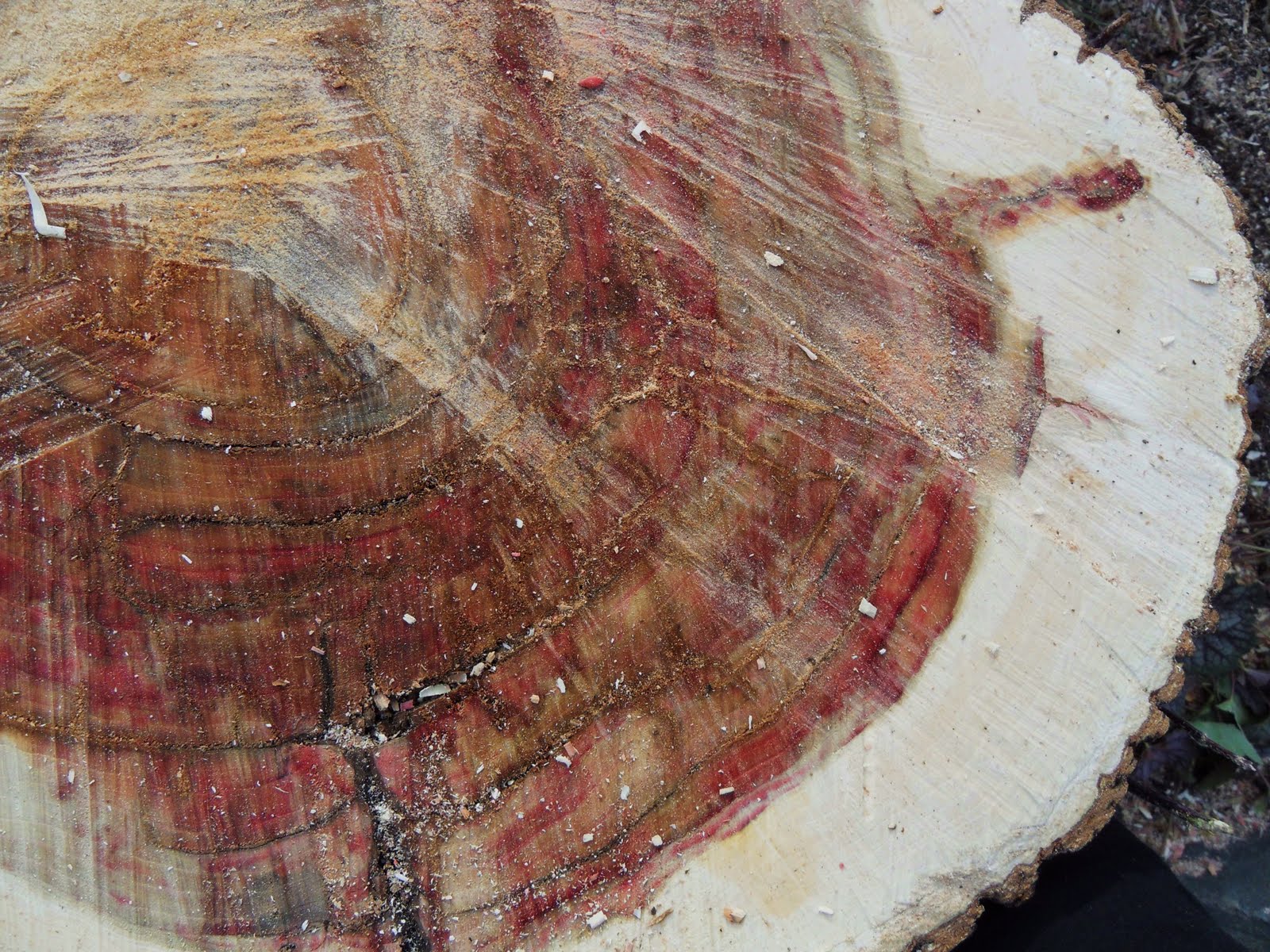
how to take down a tree

There was an old Manitoba Maple tree, 60-70 years old, in the center of my yard. A few years ago, I noticed that a large branch on the north side of the tree had started to die as it no longer was producing many leaves. So, two summers ago, after a strong thunderstorm with raging winds, I told my son, climb up into that tree and remove that branch before it falls on someone. Eventually, he got around to it. So we started taking down that old tree. After we removed that one dying branch, the entire tree looked lopsided, so we decided to take down the whole tree. But we discovered we don't have a chainsaw big enough for the trunk, so we were only able to cut it down to its central trunk.

So there it was, this big old trunk sitting smack dab in the center of our yard, branchless, leafless, all winter long, all summer long, for two seasonal cycles. I told my neighbor when she gave me the name of a tree removal company that, yes, we had to get at the tree trunk and take it down. Other friends told me they also had trees taken down and the cost was between 500- 1300 dollars, depending on the size of the tree. I looked at the tree and figured it would be about $750 if I got a company to come in to take it down.
So I got an old Finn guy to take it down. Last week I asked one of my older Finnish friends when she came by if her husband might do it for us. He is a bushworker by trade and knows how to take down trees. While retired from full time work, he stills keeps busy logging trees, especially for firewood. Nellu looked out the window at the trunk of the maple standing in the yard and asked, "That small trunk?" Jo, she said, mȁ kysyn Torstilta. So yesterday Nellu phoned me and said Torsti will come in the morning to take it down.
And that he did. I put my marking aside and went out to see how I could help. Torsti, however, is cut from the mold of the older generation Finnish Canadian men, like my dad was. They don't mind having company, but they don't need you to get in the way of getting the work done. Torsti is in his early 80s and like my father's generation of Finnish Canadian men, no work is too much for him, no job is too formidable, no job can't be done. Never mind if you've had some surgeries, may be missing a finger or a toe, have diabetes, survived cancer, or your back may not be as nimble as it was when you were younger. Never mind about that. You just tackle the job and don't complain. You don't need a crew of people to help you before you consider the work, although you know there'll be someone around to help you. Finnish Canadian men of the older generation just show up and do the job. They just tackle the job and get it done.
I have to say, watching Torsti work this brilliant autumn day, that I am going to really miss his generation of Finnish Canadian men when they all die. I really don't know anyone else like them; older Finnish Canadian men are irreplaceable. They are different company.